My name is Louise and I’m studying online in Sydney. I have a Bachelor of Social Work and Graduate Diploma in Rehabilitation Counselling. I’m married and have two children in high school (aged 13 and 16).
I returned to Sydney last year after living in London with my family for six years. In London I decided to have a change from my case management roles and worked as a Library Assistant in a public library in south London. I really enjoyed it, so I decided to have a career change and enrolled in the Graduate Diploma in Information Management. I’m currently working as a Library Assistant in council libraries in Sydney.
I find my work, study and family commitments keep me pretty busy, but in my spare time I love reading (of course), and enjoy eating out, films, gardening and golf. I’m also an absolute travel addict and have visited 48 countries so far!
It was very interesting this week to review the article by Maunder (2019) regarding Foster Library which was the first public library in Australia to introduce unstaffed 24/7 access. According to the article, RFID, security cameras, swipe card access and induction training has enabled this small, country library in Victoria to successfully extend its hours. When considering the security implications raised in the article for the public libraries where I work in central Sydney, however, it appears that a more comprehensive risk assessment may be required.
The physical risks may include theft and damage- RFID tags can be easily removed from resources (books, DVDs, CDs) and thus be undetected at the security gates; computers and equipment can be stolen or damaged; and security cameras have blind spots and can also be tampered with. There are also personal security issues that can arise with unstaffed access including violence; inappropriate or criminal behaviour; and medical emergencies. Whilst the article mentions that security cameras are in use at Foster Library, it does not detail whether these cameras are monitored and if so, what the response rate would be in the event of an emergency.
Cyber security risks may also arise from customers accessing the library’s WiFi network through the library’s computers or their own devices include hacking, viruses, worms, trojans, ransomware, phishing, malware, and other criminal or offensive use (such as accessing pornography or material on the dark web). There is also the risk of customers not logging off before their session has expired, potentially providing access to their personal information through personal websites such as banking, social media, and Centrelink. Whilst these issues also apply to staffed libraries, it can be argued that the risk increases significantly when not monitored by staff.
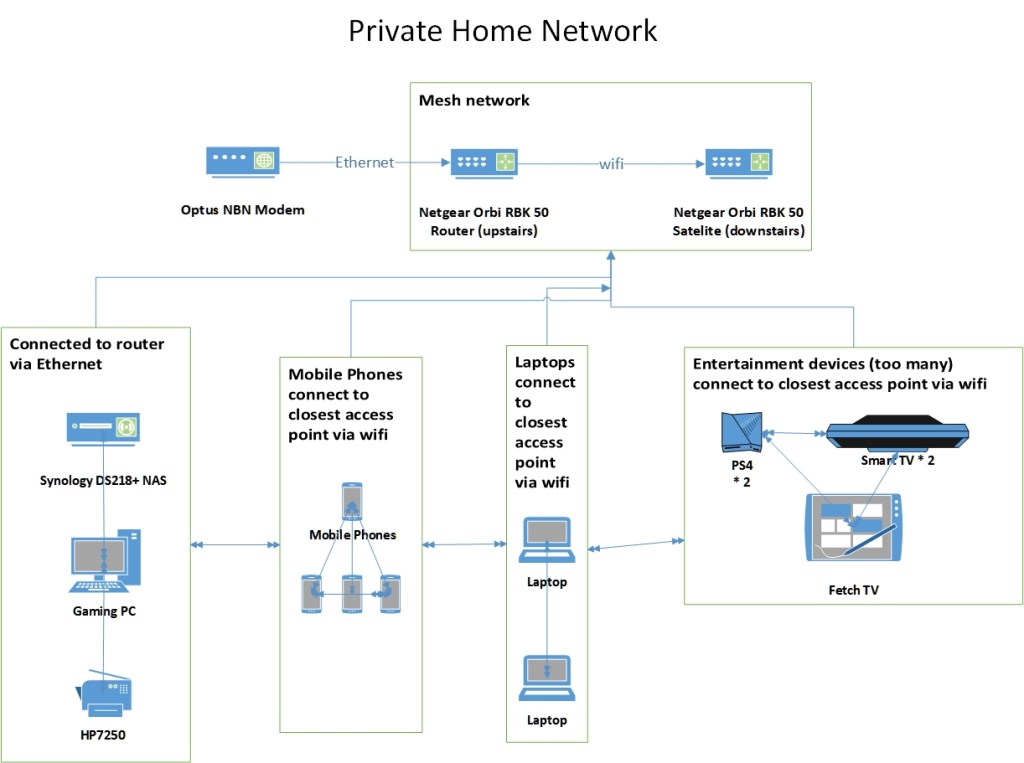
Our family has struggled for many years to obtain good Wi-Fi coverage throughout our two-storey house in Sydney. After much research, we settled on purchasing a Netgear Orbi (router and one satellite node) and set up a home network based on the mesh topology. We also signed up for the fastest speed available from our service provider on the National Broadband Network (NBN).
Our home network is shared between two adults and two screenagers (aged 13 and 16). We have two devices connected directly into the Orbi router – our son’s gaming personal computer (PC) to enable the all important ping times, and our Network Attached Storage (NAS) where all our shared data is stored. Our other devices connect to either the router (upstairs) or the satellite (downstairs) and will switch seamlessly when moved around the house. This includes two PlayStations, two connected televisions, a Fetch television box, two laptops, a multi-function printer and four mobile phones.
For security, we are not yet running a centralised firewall on the router, but Wi-Fi access is secured through a strong password. Our NAS has remote access turned off so it cannot be accessed outside of our private network. Anti-virus and firewall software is installed on each PC, and all connect to the internet through a Virtual Private Network (VPN) for additional security and privacy.
All four stakeholders are very happy with the network’s level of performance, speed, stability, and privacy. The whole family can work online, print, game, stream, and listen to music without any buffering and there are no blackspots. Two stakeholders are also very pleased with the ability to disconnect gaming and mobile devices as required, and find this particularly useful around dinner or bed time. The remaining two stakeholders, however, are less pleased with this feature!


 Libtech